June 21 –
September 27
2026
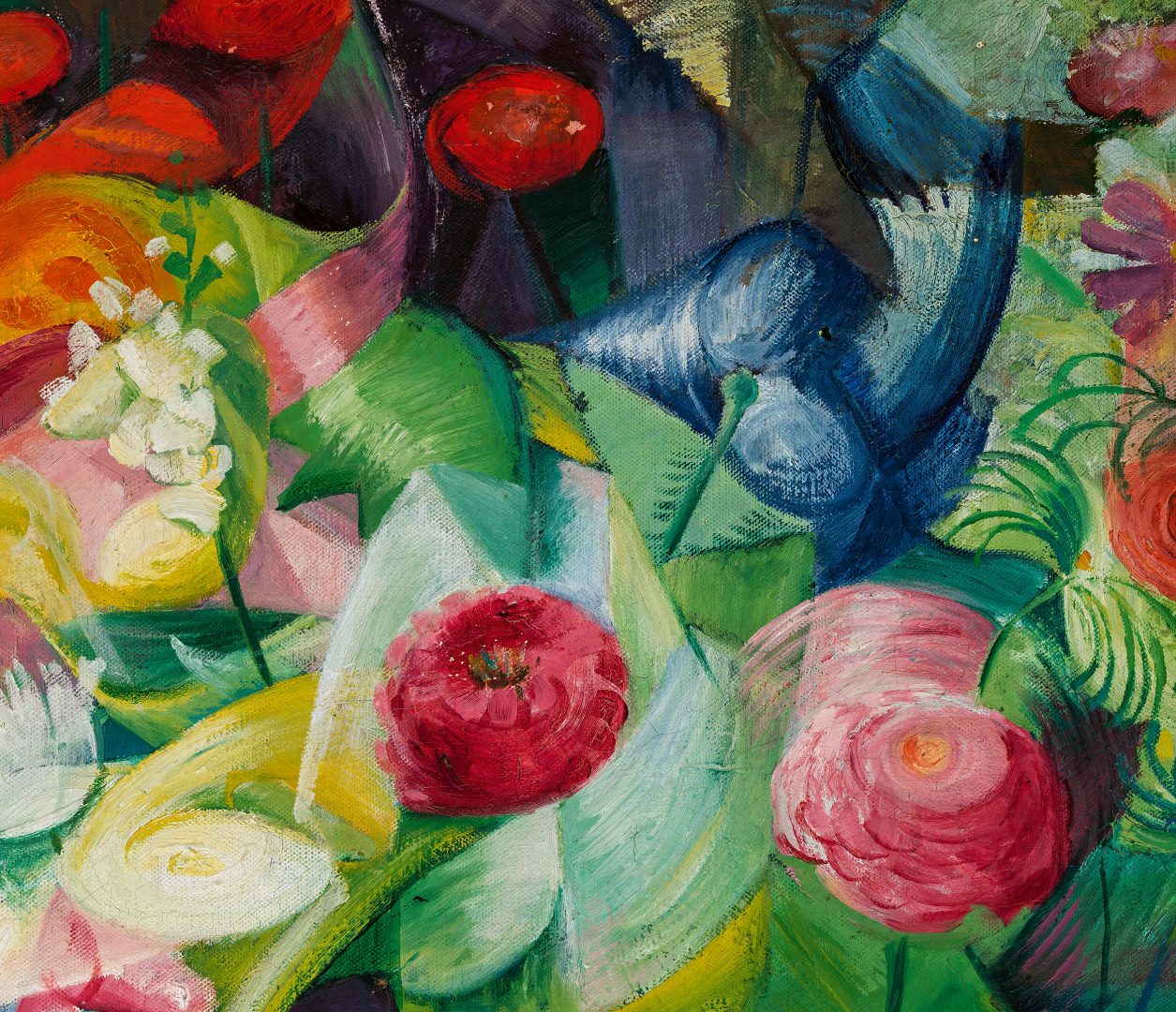
On the occasion of Maria Franck-Marc’s 150th birthday (1876–1955), the Franz Marc Museum is presenting, for the first time in the history of the museum, an exhibition devoted to her artistic work. The exhibition now turns its attention to her paintings, drawings and textile works. Flower paintings, still lifes, landscapes and children’s worlds reveal an artist who transformed familiar motifs into independent experiments with colour, surface and rhythm. What was long regarded as inconspicuous, private or secondary becomes, in her work, a field of artistic freedom.
Maria Franck-Marc wanted to become an artist long before she met Franz Marc. Already as a schoolgirl, she received lessons in music and art; later, her training led her from the Royal Art School and private women’s academies to Munich and the School of the Women Artists’ Association. Like many women of her generation, she had to find her way into art outside the state academies.
Her encounter with Franz Marc in 1905 was personally and artistically formative. At times, the two worked side by side directly from nature, exchanged ideas about painting and moved in the circle of artists from which Der Blaue Reiter would emerge. In 1912, Maria Franck-Marc was represented with three works in the second exhibition of the editorial group Der Blaue Reiter. She was therefore not merely a companion, but herself part of this artistic network.
After Franz Marc’s death in 1916, her role changed fundamentally. She increasingly set aside her own artistic work and devoted herself to preserving his oeuvre. She organised exhibitions, managed the estate and played a decisive role in shaping the reception of Franz Marc’s work. This commitment was of inestimable importance for his legacy. For the perception of Maria Franck-Marc as an artist, however, it had consequences: her own work receded into the background and remained barely visible for decades.
The exhibition thus tells not only a story of rediscovery. It also asks how visibility is created: Which motifs are considered significant? Which works are collected, shown and researched? And how does our view of modernism change when an artist becomes visible whose own work long stood behind her role as guardian of Franz Marc’s estate?
Around thirty works from private and public collections, many of which have not been seen in public for decades, now make this oeuvre accessible once again.
Artworks
Audioguide
Maria Franck-Marc
Immerse yourself more deeply in the imaginative pictorial worlds of Maria Franck-Marc with the audio guide to the exhibition Maria Franck-Marc. In around 20 minutes, selected stops accompany you through the exhibition. The audio guide combines art-historical insight with a close look at colour, surface and rhythm, showing how Maria Franck-Marc transformed familiar motifs into independent experiments of modernism.
Flowers for Maria
For the exhibition on Maria Franck-Marc, Murnau-based florist Andreas Müssig has developed a floral installation in the foyer of the Franz Marc Museum entitled Flowers for Maria. Inspired by the artist’s flower paintings, the arrangement is conceived as a work that continually changes over the course of the exhibition: blossoms open, plants wither, colours shift, and new forms emerge. In this way, the installation becomes a living dialogue with Franck-Marc’s painting — and a reflection on time, transience, and perception.
Imagination
& Form
26 April –
26 July 2026
26 April –
26 July 2026
Adolf Erbslöh (1881–1947) is regarded as one of the quiet yet influential artists of the modern era. In his essay Phantasie und Form (Imagination and Form), he formulated his own theory of art, which views imagination not as the antithesis of order, but as its very source. The exhibition Fantasy & Form: Adolf Erbslöh’s Path to Modernism follows this line of thought and invites visitors to rediscover the artist’s distinctive visual language.
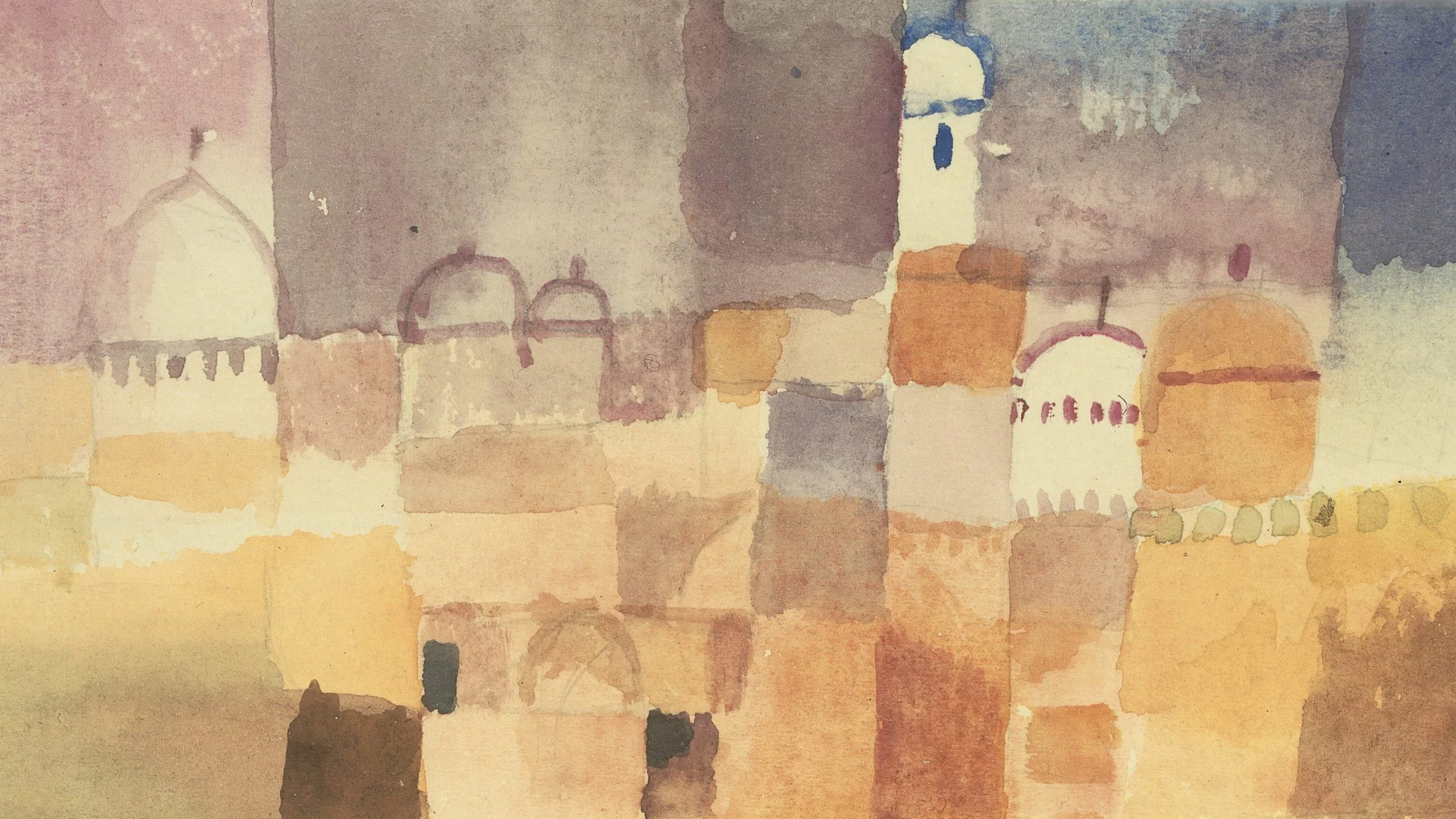
As a co-founder and later chairman of the Neue Künstlervereinigung München (New Artists’ Association of Munich), Erbslöh had a decisive influence on the artistic climate from which the Blauer Reiter emerged. He was no dogmatist of the avant-garde, but a seeker who mediated between the expressive gesture of Expressionism and the clear formal principles of Classical Modernism. In his landscapes, cityscapes and still lifes, imagination becomes a structuring force: luminous colours, clear lines and layered planes are the means of a contemplative gaze.
From his Impressionist beginnings, through his encounter with the art of Paul Cézanne and the Cubists, to the tectonic landscapes of the 1920s, the exhibition explores a central question in his work: how can the fleeting diversity of phenomena be transformed into a lasting pictorial order?
The Franz Marc Museum, whose research focus and collection are closely linked to the Munich avant-garde, presents around 40 paintings in this exhibition. Loans come from, among others, the Hamburger Kunsthalle, the Kunstpalast Düsseldorf, the Leopold-Hoesch-Museum Düren and the Schlossmuseum Murnau. Many of the works come from private collections and some are on public display for the first time. The exhibition is curated by Jessica Keilholz-Busch, Director of the Franz Marc Museum.
Artworks
Interactive Room
Imagination becomes form
Adolf Erbslöh understood art as a way of giving outward form to the inner world of imagination. In this spirit, you are invited to let your imagination run free in this space and, through playful experimentation with light, colour, contrast and transparency, discover your own form of expression.